
If you’ve recently bought a new-build or you’re in the process of purchasing one, the garage door is probably one of the last things on your mind.
There’s enough to think about with snagging lists, garden landscaping, and getting settled in.
But it’s worth a closer look – because the door the developer fits is almost always the cheapest option available, and it’s one of the easiest upgrades to make while the property is still new.
We regularly install garage doors on new-build estates, and the same points come up on almost every project. Here’s what to consider.
What Developers Typically Install
Most volume housebuilders fit the most basic garage door the specification allows – usually a single-skin, manual up-and-over in white.
It does the job in the sense that it opens and closes, but it offers minimal insulation, basic security, and limited durability.
On double garages, you’ll often find two narrow doors with a central pillar rather than a single wide opening, which can make getting a larger car in and out surprisingly tight.
These doors are chosen on cost, not on performance. The typical issues homeowners notice within the first year or two:
- Poor insulation – the garage is cold in winter and the door offers no thermal barrier
- Basic security – a manual lock that’s easy to forget and easy to force
- Limited durability – thin panels that dent, scratch, and fade
- No automation – manual operation only, no remote, no app, no auto-locking
The rest of the house is built to current Building Regulations standards. The garage door rarely reflects that same level of specification.
Upgrading Before or After Handover
The best time to upgrade is as early as possible. If you’re buying off-plan or the house is still under construction, it’s worth asking the developer whether you can specify a different garage door before completion. Some developers will accommodate this, particularly if you’re covering the cost of the upgrade.
If the house is already built, upgrading after handover is straightforward. Replacing a garage door doesn’t usually require planning permission – swapping like for like in the same opening is normally permitted development, even on a new estate.
The opening stays the same, the structure isn’t altered, and the work is typically done in a single day.
Restrictive Covenants
One thing to check before making any changes is whether the developer has placed a restrictive covenant on the property.
These are common on new-build estates and typically apply for the first few years of ownership. They might require you to obtain developer consent before altering the house’s external appearance, which may include changing the garage door.
In practice, most developers approve changes that maintain or improve the property’s appearance.
A quality sectional or roller door in a complementary colour is unlikely to be refused. But it’s worth checking the wording of the covenant and obtaining written consent before you order.
NHBC Warranty Considerations
New-build properties come with an NHBC Buildmark warranty or equivalent, covering defects for up to ten years.
Modifications to the property during the warranty period don’t automatically void the cover, but if you make a change and a problem arises in that area, the warranty provider may argue the modification contributed to the issue.
Fitting a new garage door into the existing opening – without altering the structure – shouldn’t cause warranty problems, but it’s sensible to use a professional installer and keep records of the work.
What to Look for in an Upgrade
The main gains from upgrading a developer-spec door are insulation, security, automation, and appearance. A good replacement should deliver all four.
- Insulation – double-skinned panels with a foam core keep the garage warmer and reduce heat loss if the garage is attached to the house
- Security – automatic locking with no external handles or keyholes, and ideally PAS 24 certification for homes with internal garage-to-house access
- Automation – remote control, smart app options, battery backup, and manual override
- Appearance – colour-matched to the front door, windows, or cladding so the garage door sits properly within the elevation
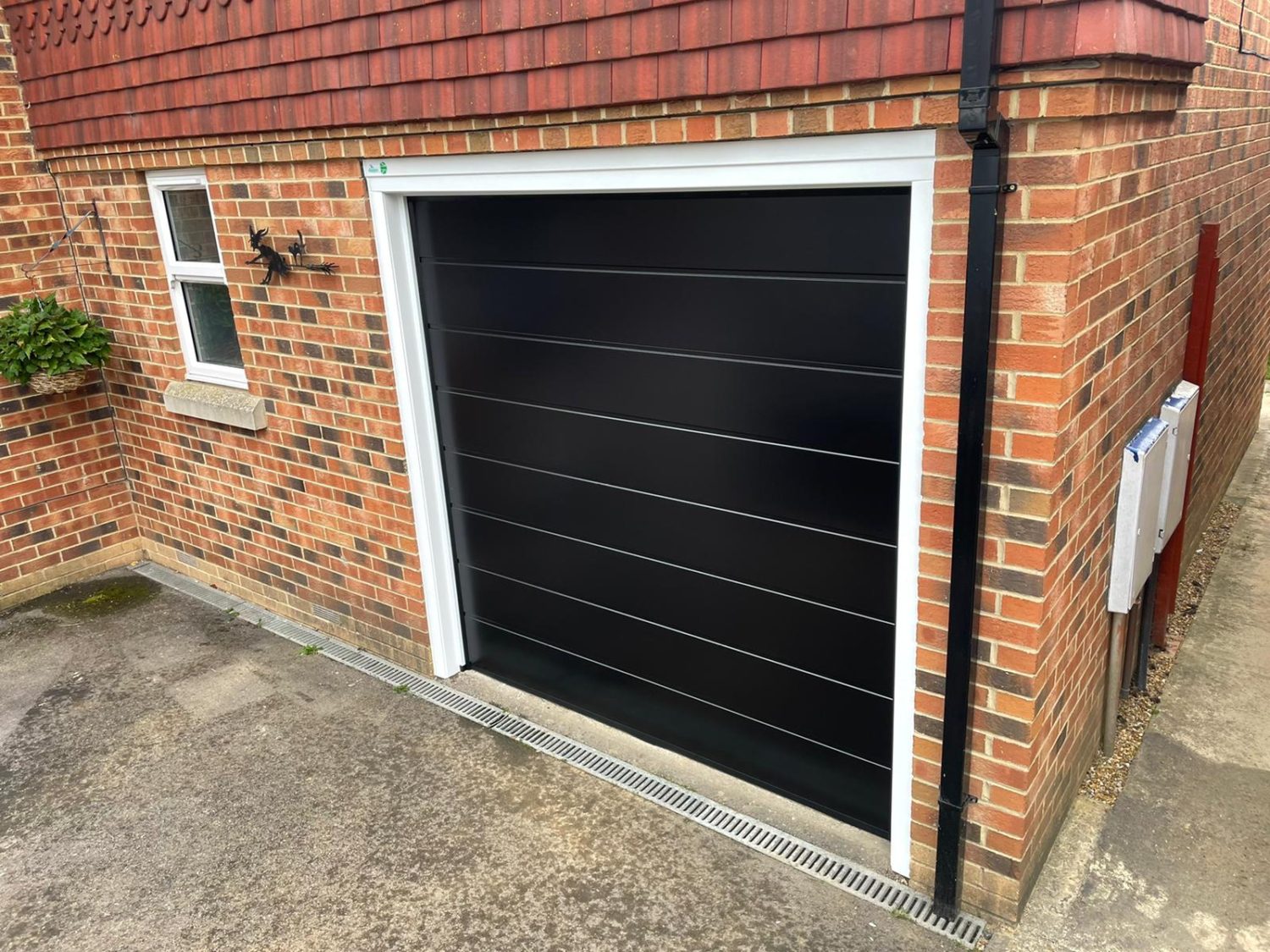
Our G90 sectional garage doors and G91 roller doors cover all of these. Both are manufactured at our workshop and fitted by our own installation team in a single day.
Garage Doors in Hampshire, Surrey, and Beyond
We install across Hampshire, Dorset, Wiltshire, Surrey, Berkshire, West Sussex, Oxfordshire, and Buckinghamshire.
New-build estates are a regular part of our work, and we understand the practicalities involved to smooth out the process for you.
If you’ve moved into a new-build and the garage door isn’t up to scratch, or you’re buying off-plan and want to specify something better from the start, request a free survey.
Our surveyor will visit, measure the opening, and give you an instant quote on the day.
Request a free survey
"*" indicates required fields